Pages

Showing posts with label inference. Show all posts

Monday, October 27, 2014

Balloons Around the World Week

The first Wednesday of October is Balloons Around the World Day.  On that day we celebrate the joy and delight that balloons bring to our lives.  I created a week focusing on balloons going on trips around the world.  I think next year I may create some activities about balloon animals or something like that, but for now, let me show you what we are doing in my speech room for that week.

Around the Globe Articulation:
I created a fun activity to drill articulation words using a globe.  I painted my globe so all you could see were the continents and oceans but a regular globe works just as well.  The students spin the globe and put their finger somewhere on it to stop the movement.  Whatever they land on tells them how many words to say, how many times to say a word, and/or to put the words in a sentence.  The kids think it is fun to see where their fingers end up on the globe and you can get a bunch of repetitions this way.  

Get your Articulation Around the Globe activity here!

Size of the Problem Balloons:

Most of my kids working on pragmatic language/social skills have a hard time determining the size of a problem (to assess how they should respond in terms of behavior) and then deciding how to solve that problem.  Therefore, I created an activity to work on social problem solving.  The kids determine the size of the problem listed on the card and discuss how to solve it to keep their cards.  Sometimes they might draw a card stating their "balloon is losing air" and you take away the number of cards listed.  The person with the most cards at the end of the game wins!

Get you Size of the Problem Balloon cards here!

Balloon Prepositions:


To work on prepositions, I printed off my balloon pictures along with images I found online of different parts of the world and asked the kids to place them in different areas of the pictures.  I can work on prepositions receptively by asking them to place the balloons and expressively by putting the balloons in different areas of the pictures and asking them to tell me where they are.  Sadly, I am not able to give you the balloons as images without putting them into a printable activity and I don't have permission to give out the on-line images, but I wanted you to know about the idea of the activity if you want to make it yourself.

Book Units:

Ben's Dream by Chris Van Allsburg is great because there are several pages without words showing parts of major landmarks around the world.  I found pictures of the actual landmarks and had the kids draw inferences about what landmark he is traveling to and give them a little information about it.  I then check their auditory comprehension by going back and asking questions about the landmarks he visited.

Get Ben's Dream here!!

Up!  by Random House Disney is a good book to work on WH questions, prepositions, and feelings.  My intern created a list of questions to go along with the book that I am adding here for you to use.


Get Up! here!!

Where Do Balloons Go? by Jamie Lee Curtis looks super cute!! I have not lesson planned it since I found it after my week ended.  I will work on this one for next year but I thought I would add it now so you have another book to use.

Get Where Do Balloons Go? here!!

Happy Ballooning!!!
Photobucket
Pin It!

Wednesday, September 18, 2013

2nd Annual Pirate Week

Last year I started my theme weeks with Pirate Week for National Speak Like a Pirate Day.  Well, that day is today and my kids had so much fun with this week last year that I had to bring it back.  I added a few extra games and activities to change things up and also a few more books.  Please refer to my previous post for the majority of my plans.
Eye Patch!!:
My kids LOVE Headbands and I do too because there are so many things you can work on with that one game: categories, descriptive features, inferencing, articulation, voice, fluency, etc. My current intern had the idea to attach artic cards to an eye patch and make it more pirate related. (Can I also just take a minute and say how thankful I am for my graduate school alma mater, University of Texas at Dallas, for supplying me with the BEST interns!!! I mean, they are really spectacular.  I have been SO BLESSED with the wonderful ladies whom I have had the pleasure to work with these past few years!!! Sorry, that just needed to be said.)  For my artic kids, I used SuperDuper artic cards for the sounds they are working on.  I used the same cards for all of my other kids, it just didn't matter what sounds I used.  After three days of this game being used at all different levels I can tell you it is a success!!!  Good thinking Morgan!!!

Pirate Pictures:
A bunch of my kids with AU are working on determining a person's/character's feelings/motives/intent through nonverbals so I thought I would print off some pirate pictures for them to look at and discuss.  We focused on three main things for each picture:
1. What the characters are looking at
2. What the characters might be thinking
3. How the characters are feeling
When I was looking for good pirate pictures to use online, I discovered that most of the pictures are not quite appropriate for my kids.  I was feeling kind of low about this fact, and then the clouds parted, and the sun shined down on The Pirates! Band of Misfits.  I have never seen this movie, however what I do know about it is that it is a stop motion film where the characters have great facial expressions and big eyes so you can follow their eye gaze.  I found 20 different pictures online, pasted them into a pirate boarder, and voila! my pirate pictures were born.  I do not know the copy write info on taking pictures from movies so I'm not going to post them to my TPT store, but I will post them here.  So, for anyone who asks, these pictures all came from The Pirates! Band of Misfits which is a movie by Columbia Pictures, Sony Pictures Animation, and Aardman Animation.  Hopefully that is enough credit ;)

Get your Pirate Pictures here!!!


Pirate Talk:
My artic kids have been working SO hard over the past year on learning how to say all of their sounds so a bunch of them are now at the conversational level. Last year we played a game created by Jenna Rayburn from Speech Room News called Capture the Jolly Roger to work on conversation. I wanted to add another level to the game by creating some questions/conversation starters to elicit even more connected speech from them. You can use the cards alone or in conjunction with the game Jenna created (see previous post). They are also my first product on my TPT store!!! Don't worry, they are still free, I'm just moving everything over there instead of Google docs from now on.

Get your Pirate Talk cards here!!!


Books:
The last additions to my Pirate Week activities are some new books: Pirate Soup by Erica Farber and J.R. Sansevere and Edward and the Pirates by David McPhail.  Both books are relatively short so you can do other activities with them.  I make picture cues for Pirate Soup to work with my younger kids on sequencing and retell and am using the Story Grammar Marker to retell Edward and the Pirates

I hope you can use any or all of these activites.  Don't forget to look back at my previous post for more!!!

Photobucket


Pin It!

Wednesday, March 6, 2013

Monster Week

This is quite possibly my favorite week so far.  The funny thing, is I had scheduled to do a chocolate week for this week because I found some random chocolate holiday to celebrate, but I purchased some great monster activities from Teachers Pay Teachers and I wanted to use them.  Monster week was planned and the rest is history.

Before getting to the activities, I need to tell you about my monsters.  I found this cute "tattle monster" idea on Pinterest and decided to make some for myself.  I sent an email out to the teachers at my school asking for empty tissue boxes and egg cartons, and the response was great!!  I had enough to make four monsters for me and four for my intern.  If you can't find these guys anywhere and want to know how to make them, let me just give you the directions now...

1) Paint tissue boxes your desired color.  Once dry, use the bottom of a large paintbrush to dip in paint and create your dots.  (** You can use spray paint but I didn't have spray paint and didn't want to buy it, so I used white paint to paint a base coat on the boxes and then painted over it with my desired color.)
2) Seal paint using decoupage.  The paint will chip off of the boxes if you do not seal it.  I decoupaged the boxes and it worked well.
3) Cut the mouth hole a little bigger to give your kids enough space for the teeth and their hands.
4) Cut teeth out of white foam paper and attach to the inside of the mouth using a hot glue gun.
5) Cut egg carton into individual egg holders, attach googly eyes, and glue to the top of the monster.
6) HAVE FUN!!

I used my monsters in a variety of ways...

Reinforcers:
I told my kids that my monsters were very hungry but they only ate candy.  I gave them chipper chat pieces to feed the monsters (that I had placed throughout my speech room) and the kids got to feed their monster of choice as a reinforcer.
(**extra fun hint: I told my kid that although my monsters liked candy, if they put their hands in the monsters' mouths, they would be eaten.  I gave them my "magic wand" to collect the chipper chat candy from the monsters' mouths at the end of the speech session.  They loved using the magnet to collect the "candy" pieces.)

Categorizing/Comparing and Contrasting:
 Although each monster was a different color, I only used four colors for the dots.   They kids could categorize the monsters by dot color, size of box (there were three sizes), number of eyes, type of mouth, or type of teeth (curly, spiky, two layers, etc.).  They could then compare and contrast the monsters based on their characteristics. 

Like I said earlier, I found some great therapy materials from Teachers Pay Teachers to use this week.  Here are the links to the monster materials I used:

Social Candy Monsters were used with my social skills/spectrum kids.  (that is where I got the idea to feed my monsters candy) You can find the blog about them at Crazy Speech World or you can buy them from Jenn's TPT store.


Another cute monster activity that Jenn at Crazy Speech World made (and this one is FREE) is Conversation Starters.  (These cute pictures might not be monsters but that is what I called them so I could use them this week, so use them however you want.)  I used these with my kids working on anything at the conversational level.  Get them from Jenn's TPT store for free!!

The Monster Question Pack was great to use with any of my kids that were working on asking or answering questions.  It also came with cute monster mouths that I cut out and attached to sticks as a form of a mask (I used them as ways to "buzz in" to answer a question and just as a mask for my kids to use while answering; they loved this!!)  You can find the blog about them at Live Long Speech (but it is by the author of Sublime Speech) or you can buy them from Daniele's TPT store.

Back Pocket Monsters is an oldie but a goodie.  These two games were created by Jenna over at Speech Room News and my kids LOVE them every time we play them.  You can find the blog about them at Speech Room News where I think she is still giving them away for FREE!!

My sweet intern found this story/activity to teach expected and unexpected behaviors in the classroom: Monster Fun! Teaching Manners and Expectations.  It comes with two stories: one about listening with your different body parts (e.g., listening with your hands) and a story about a monster who shows up to school and uses unexpected behaviors.  We read both stories and then discussed what school rules the monster broke and how he could change his behaviors to become expected.  You can get it at the Growing Kinders TPT store for FREE!!

Go Away Big Green Monster by Ed Emberley is a great book to work on sequencing skills.  I made a felt version of the monster and had the kids add the parts and then remove them when the story told them to.  We then used picture versions of the book to sequence when each part was added and removed and then retold the story using first, then , next, and last. 
 Glad Monster, Sad Monster by Ed Emberley and Anne Miranda was used in conjunction with Michelle Garcia Winner's Think Social! Lesson #7: Using Our Brains to Think About Others.  We read the book and then talked about how each monster felt and what might have caused them to feel that way.  The kids then picked feelings to portray and used the monster masks in the books to portray them.

Substitute Creature by Chris Gall is a great story to work on predicting and drawing inferences.  It is a story about a substitute teacher who teaches the students of a misbehaving class "cases" about children who do certain unexpected things (e.g., doodling, playing tricks, stealing things, etc.) and their consequences.  My kids loved this story because of its great illustrations and they liked to predict what the case would be. 

I hope you enjoy monster week!! We had a BLAST in my room!!
Photobucket
Pin It!

Tuesday, March 5, 2013

Thank a Mailman Week!!

First of all, I need to apologize for not posting sooner.  We have been doing all of these great weeks in my speech room, but I just haven't had the time to blog about them.  So now I am going to try to back track and blog about past weeks and you can use them next year when the holidays come up.

We will start with Mailman week...February 4th was Thank a Mailman Day, so in honor of our postal workers, we decided a Mailman week was in order!!!  We created a bunch of fun activities that are related to the mail, letters, or packages for our kids to do.
Following Directions:
My new intern (whom I LOVE by the way...quick shout out to UTD for sending me the BEST interns this year!!!) came up with this activity to put colored tape around boxes (she bought it in the $1 bin at Target) and create following directions/building a tower activity using multiple modifiers.  First we used the boxes to categorize (size, color, fun tape/no tape, etc.), then we had the kids follow the directions to create a tower.  One of my kids was working on left and right, so we also added "left" and "right" cards in our directions for her.  Of course, my kids' favorite part of building the tower, was knocking it down.  

Get your Tower Directions here!!


I used these mailboxes in the following activities.   I found them at the $1 spot at Target but I am sure you can get them other places as well.  Sometimes my kids like to have a place to store their earned cards.  It makes it a little more fun to earn things so that is one way I used my mailboxes...


Figurative Language:  
I have a bunch of kids that work on figurative language because, let's face it, figurative language is hard for our kiddos with language impairments and our kids on the spectrum.  I made this game to work of idioms, similes, and metaphors.  First I talked about what each type of figurative language skill is, and then we went into the fun filled time of earning letters.  

Get your Figurative Language Game here!!


Drawing Inferences:
We used these cards to work on drawing inferences and for the articulation/voice/fluency kids who are working on their strategies in connected/conversational speech.  For my language kids, I read the letters and then we talked about the information that was HERE and the information in our HEAD that we could use to find out what is HIDDEN.  For my conversation kids, they read the cards and then talked it out with each other to come up with the hidden information.  I own this great game, 30 Second Mysteries for Kids, that I took some mysteries from to create my letters.  I can't gift you my letters because that would be stealing from the great people of University Games, but I wanted to at least give you my idea.

Here is a link to 30 Second Mysteries for Kids on Amazon if you want to buy it.


Emotions:
For my kids working on determining emotions from tone of voice, I used the mailboxes to categorize types of feelings.  All of the good feelings were put into the blue mailbox, the not so good feelings were put into the red mailbox, and the silly feelings were put into the pink mailbox.  We started the activity by listening to voices via YouTube with the types of feelings on the table as choices for what voice it was.  After guessing what other people's voices sounded like, we gave a "emotion letter" to each student and had them say a sentence using a voice represented by the emotion we gave them.  The other kids guessed what voice they were using and then they categorized the voices into the mailboxes.  My kids LOVED this activity!! They especially loved using the robot and monster voices.  They even danced like robots while saying things with the robot voice.  It was hilarious!! (Amazing what your kids will think to do)


Big Problem/Little Problem:
I am a HUGE fan of Michelle Garcia Winner.  Pretty much anything she publishes I buy, so the Big Problem/Little Problem lesson is something I do with all of my kids on the spectrum.  Using the Big/Medium/Little Problem visuals from Jill Kuzma's blog, we talked about the levels of problems and some examples of them.  We then gave each student their own mailbox with letters inside it.  Each child pulled out a letter and we read what the problem was.  Then the student had to decide if the problem was big, medium, or little and put the letter under the Jill Kuzma visual.  

To go to Jill Kuzma's site and get her visual click here...
Get your Problem Letters here!!


iPad Reinforcer:
For all of my little ones who love to play on my iPad, I found a cute mail truck reinforcer for $0.99.  The kids got to pick up mail, bring it to the Post Office, separate it based on color, and then bring it to the airplane to send it off to other places.  You can also work on colors if you need to using this app.

Get the Mail Truck App here!!

Speech Mail:
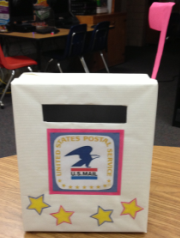
We wrote letters to each of our articulation kids with either a list of words/sentences to say or a stack articulation cards in them.  At the end of the speech session they mailed their letters back to us in the speech mailbox (shown above) made out of a boot box.  It was amazing how the kids responded to their letters.  I work in a Title 1 school and not a lot of my kids have ever received mail, so it was nice for them to get a letter, even if it was only in speech.

A Small Dog's Big Life: Around the World with Owney by Irene Kelly:
This book is super cute and talks about a dog who lives in a Post Office.  It is written in letter and newspaper form to talk about his adventures as he travels around the world with different postal workers.  The book is good to work on vocabulary and to talk about different forms of communication throughout history (e.g., letters, telegrams, etc.).  It is long, so we just picked different parts of the book to read and did not do the entire thing.  

Hope your kids have as much fun with this week as mine did.  The best week is next, MONSTER WEEK!!!
Photobucket
Pin It!

Thursday, November 29, 2012

Bathtub Party Week

December 5th is National Bathtub Party Day!!  Yep, that's right, an actual day devoted to having a party in a bathtub.  I have absolutely no idea why this day exists, but because I just so happen to have a bathtub in my speech room, I thought I would create a theme week around this random holiday.


I normally only let me kids sit in the bathtub when they buy "Tub Time" during prize week, but I am going to let them take turns sitting in the tub during speech this week due to the theme.  I plan on bringing a short folding table in so the kids in the tub can still participate in the speech activities without getting out of the tub.


I created a few bathtub related activities to do with my speech kids that I thought I would share.
Defining Words:
Using a cloze sentence, the children will define bathtub related vocabulary.  Start by explaining category, function, and what a distinctive feature is before asking them to define words. 


Following Directions:
A bunch of my kids have a hard time with following directions especially ones using "before" and "after", so I whipped up some three and four step directions using those pesky temporal concept words. 


Drawing Inferences:
This skill always needs a little more work, so I created an activity targeting drawing inferences based on "hopefully" real life situations.  Let me know if you like it.


Four Types of Sentences:
For all of those who have fourth graders with goals based on the forth grade TEKS, this is the activity to you.  The kids have to determine if the sentence they draw is a declarative, exclamatory, interrogative, or imperative sentence by placing the rubber duck on the correct bathtub. 

Get the Bathtub Activities here!!

Rubber Duckies:
My sweet intern found these rubber duckies on amazon for $6.  To get them go here

The great thing about these particular rubber duckies is they are so colorful and come is sets.  I plan on hiding them around the room and having the kids find the ducks and then using qualitative and prepositional concepts, explain what duck they found and where they found it.  I can hold up one duck and ask the kids to find it's match, can ask them to find another duck of the same color but a different design, you get the picture. 

These ducks can be used to compare and contrast by color, design, the fact that they are all ducks, etc.  You can also use the ducks to work on quantitative concepts by passing them out in different amounts and asking the kids who has more, less, etc.   

We are planning on putting clues on the bottom of the ducks and having a little scavenger hunt as well.  I found pictures of different things related to rooms in my school and took pictures of parts of items in my speech room for the students to use as clues to infer where the next rubber ducky is hiding.  The last clue is part of a candy jar in my room, so each kid will have a reward at the end of the hunt.  Here are the clues I am using on the bottom of ducks.

 
Ok, wish me luck on letting my kids spend a week in a bath tub!!  


Photobucket
Pin It!